


Aussie savvy versus Kiwi
 Huon Hooke in Free for all
 Become a member to view this article
The Real Review is editorially independent. We don’t sell wine. We are free of influence from vested interests such as wine producers and sellers, and proprietors with conflicts. We tell you what we think about reviewed wines, served straight up. Our articles cover topics our writers choose because of genuine interest.
We rely on our members to publish The Real Review. Membership provides access to thousands of articles, a growing database of more than 160,000 wine tasting notes, exclusive member discounts and more.
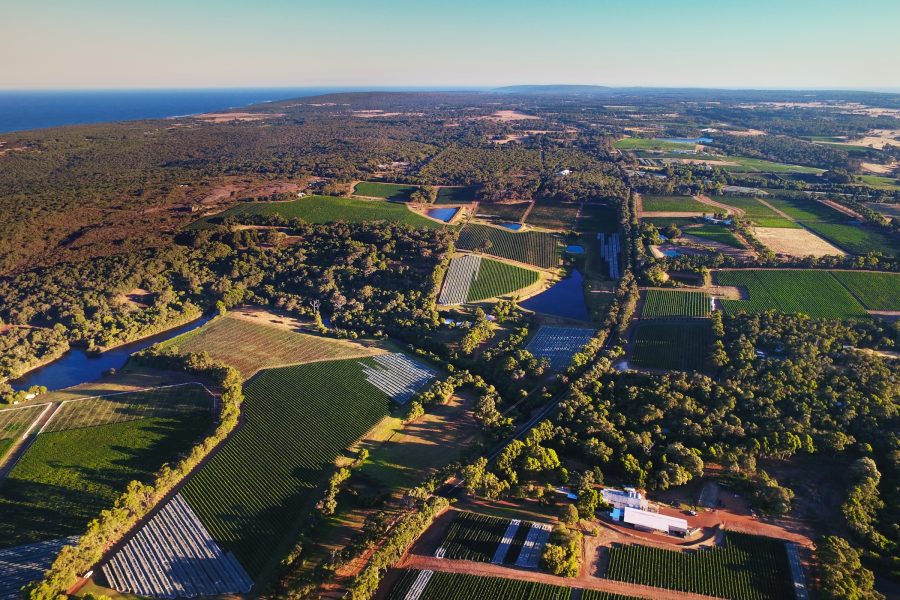
Margaret River has great success with its blends of sauvignon blanc and semillon. Margaret River Wine Association
Guide to Sauvignon Blanc & Semillon Feature Week
Australia has a great appetite for sauvignon blanc. Sauvignon blanc accounts for one in every eight bottles of wine purchased in the Australian off-trade (retail) market, according to Wine Australia. Most of it comes across ‘The Ditch’ from New Zealand.
Sauvignon blanc is 4.5% of the total area of grapevines planted in Australia, or 12.6% of the white vines.It surprises many people that despite our thirst for the Kiwi product, Australian sauvignon blanc is also quite a big item: it’s the second-most widely grown white grape after chardonnay.
Australia has 6,097 hectares of sauvignon blanc (2025 Wine Australia figures). There are 21,442 ha of chardonnay. Third on the list is semillon with 4,569 ha* and fourth is pinot gris/grigio, with 3,731 ha.
The sauvignon blanc number pales in comparison to New Zealand’s 29,000 ha, though.
Sauvignon blanc is 4.5% of the total area of grapevines planted in Australia, or 12.6% of the white vines. The planted area more than doubled in the decade between 2001 and 2010.
In 2025, 115,110 tonnes were processed for wine, which was 15.8% of the white grape crush. When compared with the area planted, this tells us that yields per hectare are higher for sauvignon blanc than the average.
Where is it grown? Pretty well every region grows some sauvignon blanc, but the biggest are the inland irrigation areas—the Riverland, Murray-Darling and Riverina, with 77% of the vines. Margaret River has just 5%. That leaves just 18% for all the other regions.
Margaret River and Adelaide Hills are the two most prominent regions for high-quality sauvignon blanc varietal table wines. Other notable high-quality sources are Orange, Tasmania, King Valley and Yarra Valley. Sauvignon blanc (or simply sauvignon as it’s known in France, the biggest producing country) is a cool-climate variety, although like all grape varieties it can be grown in a range of climates, but only produces wine of distinctive character reliably when grown in cooler places.
How do Aussie savvies taste compared to the Kiwis?
I would say New Zealand, especially Marlborough, has cornered the market for highly aromatic fruit-driven sauvignon blanc, often slightly sweet. It’s the intensity of fruit and immediate drinkability that have made it a big hit on the world stage.
Australia has produced few wines that match the Marlborough style. Even Tasmania, which is on exactly the same latitude as Marlborough, seldom if ever makes wine that tastes like Marlborough. Put that down to terroir.
Our wines are generally less lifted in their fruit, less fragrant, less pungent if you like, but can still be very varietal, especially in the colder climes. They also tend to be a little drier, more savoury.
Of course I’m generalising: there are many wines in Marlborough that don’t conform to the stereotype, and there are plenty of examples of complex, barrel-fermented, more ‘worked’ sauvignons in both countries. These wines aim for complexity and texture; to do more with the grape than capture simple fruitiness.
Semillon is a footnote to the discussion, as so little is grown to be marketed as a varietal wine compared to sauvignon. As a stand-alone, it’s a relatively minor grape in Australia and is even less visible in New Zealand.
I would say New Zealand, especially Marlborough, has cornered the market for highly aromatic fruit-driven sauvignon blanc, often slightly sweet.Semillon is very selective as to places where it produces great wine. Australia’s Hunter Valley is head and shoulders above the rest. It has the unique combination of soil, climate, and other influences (not to mention the history of human experience with semillon) that gets the best out of the semillon grape. The Barossa and Clare Valleys make some excellent wines of a fuller style.
Western Australia, especially Margaret River, has great success with its blends of sauvignon blanc and semillon, but is less successful with stand-alone semillon.
More than half Australia’s semillon is grown in the Riverina, where it is used as an inexpensive bulk blending variety, but also in the region’s one and only luxury product: sweet botrytis-affected semillon, spearheaded by De Bortoli’s Noble One.
There is an argument that sales of Australian dry white varietal semillon fell off a cliff when the New Zealand ‘savalanche’ got going. Once-famous Barossa semillons such as Peter Lehmann and Basedow, which used to sell hundreds of thousands of cases a year, are now non-existent. The theory goes that Barossa semillon drinkers dropped these wines and switched to Marlborough savvy. This may not seem like a logical case of substitution, but could just be true.
*There are more planted hectares of semillon than pinot gris but more PG was crushed than semillon in 2025.