
The third iteration of Piper-Heidsieck’s Hors Série
 Anthony Rose in Wine Spotlights
 Become a member to view this article
The Real Review is editorially independent. We don’t sell wine. We are free of influence from vested interests such as wine producers and sellers, and proprietors with conflicts. We tell you what we think about reviewed wines, served straight up. Our articles cover topics our writers choose because of genuine interest.
We rely on our members to publish The Real Review. Membership provides access to thousands of articles, a growing database of more than 160,000 wine tasting notes, exclusive member discounts and more.
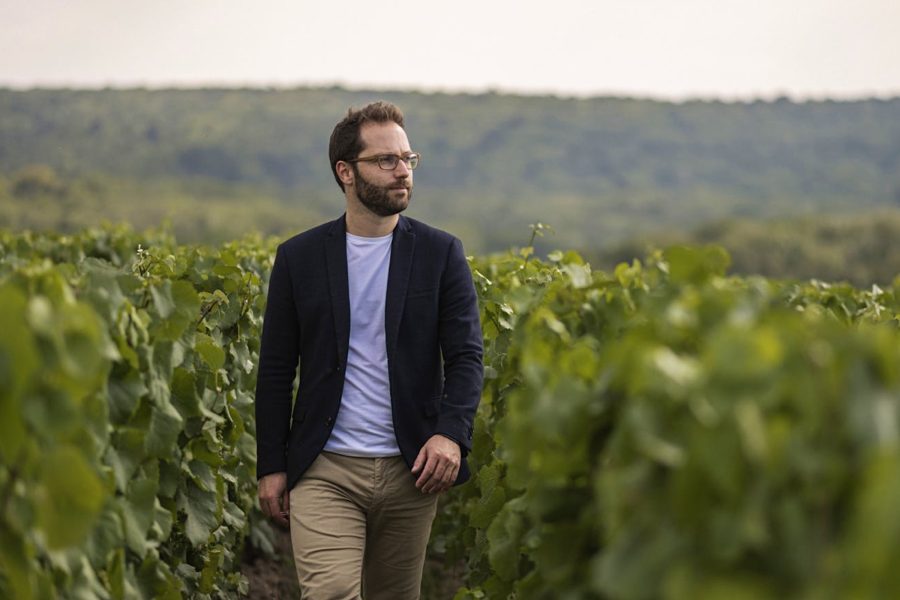
Piper-Heidsieck’s chef de cave Emilien Boutillat. Champagne Piper-Heidsieck
When Emilien Boutillat, Piper-Heidsieck’s dynamic chef de cave, came to town with the latest Hors Série creation, everyone was anticipating bubbles. Why wouldn’t you if the chef de cave was in town to show off the latest wine? But the main man had a surprise up his sleeve, as it were, and, as the name implies, he came up with something radical.
The third Hors Série instalment is not just a still, dry white wine but a still white made from black grapes, pinot noir to be precise.The debut 1971 Hors Série set the tone, followed by the 1982 vintage—a prestigious and nostalgic nod to the house’s heritage. For Boutillat, who joined Piper-Heidsieck in 2018 and was not yet born when those early editions were released, the desire to mark the collection with his own personal stamp was irresistible. The third Hors Série instalment involves thinking outside the box: not just a still, dry white wine but a still white made from black grapes, pinot noir to be precise.
Historically, Piper-Heidsieck once dabbled in still wines, producing a Vin Tranquille de Champagne made from pinot noir. Such wines were not unheard of; in the 1960s and 1970s, with Laurent-Perrier leading the charge with similar styles. Fast forward to 2024, and Piper-Heidsieck’s latest twist sees the return of this category under its official appellation: Coteaux Champenois.
Coteaux Champenois is an appellation introduced in 1973, officially recognising the region’s still wines. Traditionally, whites were chardonnay, reds pinot noir. At first glance, Boutillat’s interpretation seems counter-intuitive. Yet as he explained, it couldn’t be more logical. Blanc de Noir champagnes are central to Piper-Heidsieck’s identity, so creating a still version extends a house signature rather than contradicting it.
The idea germinated in 2019, as climate change began shifting ripeness levels in Champagne’s vineyards. Grapes once too tart for still wines were now achieving unprecedented balance. For Boutillat, the message was clear: adapt and innovate. Two small vineyard parcels—each only about one hectare—were chosen for this experiment. In Aÿ, the north-east facing Chauffour parcel, planted in 2004, provided a cooler, crisp profile. In Ambonnay, Champs Seaux, planted in 2010 on southwest slopes, promised depth and richness.
Pruning was adjusted to enhance concentration. Trial wines from 2021 didn’t meet expectations—so they were never released. Then came 2022: a ‘wonderful vintage,’ according to Boutillat. The grapes achieved perfect ripeness, balancing vibrancy with finesse.
Harvested by hand in small crates to maximise the terroir element, the pinot noir was pressed in a traditional Coquard press. Only the tête de cuvée—the first and finest fraction of juice—was used, representing roughly 25% of the total. Vinification was carried out in stainless steel with full malolactic fermentation, although the malic acid was low in 2022, and the wines, after resting on fine lees for a year, were bottled under screwcap and aged another year before release.
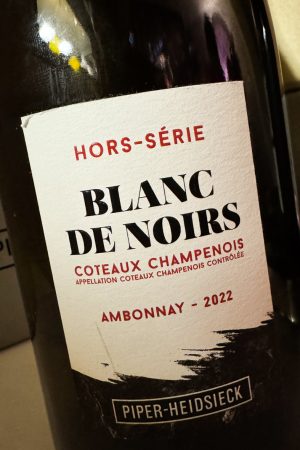
Piper-Heidsieck Hors-Série Coteaux Champenois Ambonnay Blanc de Noir. Anthony Rose
The result is wines which you would be hard to place blind for a variety of reasons. They challenge tasters to locate them geographically. Still white wines made from pinot noir are rare enough; from Champagne, they’re few and far between. Only 3,000 bottles of each cuvée exist, intended for discerning markets in the US, UK, France, Italy, Austria, Australia and Japan. Boutillat predicts graceful evolution over time, with hints of toastiness developing as they age.
This may not be an every-vintage occurrence, but Piper-Heidsieck’s long-term goal is clear—to establish Coteaux Champenois as a permanent pillar of the house portfolio. With changing climates and growing expertise, still wines from Champagne could soon move from curios to mainstream expressions.
To dismiss the new Hors Série as a publicity stunt would miss the larger point. Coteaux Champenois isn’t likely to threaten Champagne bubbles—or Burgundy’s dominance—any time soon. But as the climate inexorably changes, the region’s still wines are fast gaining both viability and allure and this bold venture captures a glimpse of an evolving identity for the Champagne region.
Piper-Heidsieck Hors-Série