


Five questions with Felton Road’s Nigel Greening
 Bob Campbell MW in Five Questions
 Become a member to view this article
The Real Review is editorially independent. We don’t sell wine. We are free of influence from vested interests such as wine producers and sellers, and proprietors with conflicts. We tell you what we think about reviewed wines, served straight up. Our articles cover topics our writers choose because of genuine interest.
We rely on our members to publish The Real Review. Membership provides access to thousands of articles, a growing database of more than 160,000 wine tasting notes, exclusive member discounts and more.
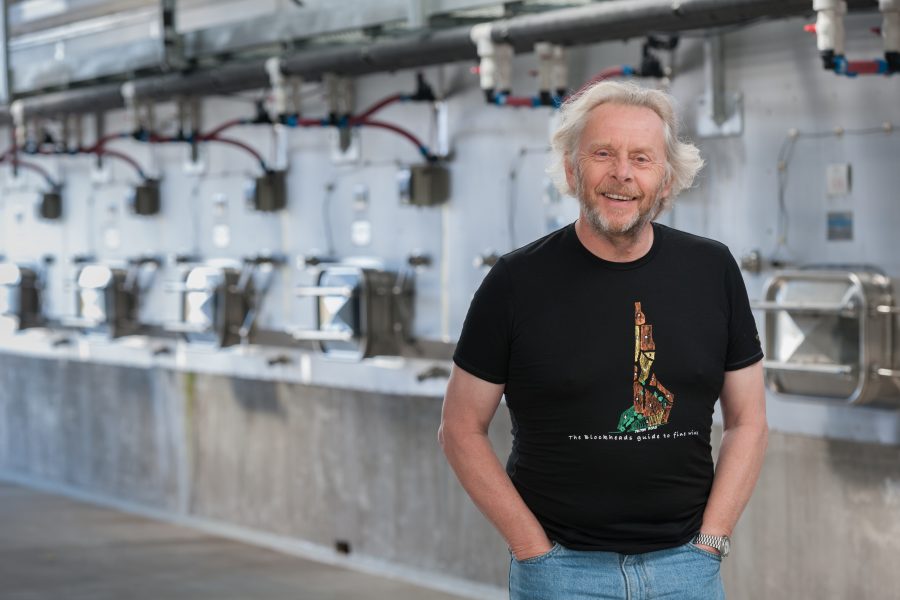
Nigel Greening of Felton Road. Supplied
Nigel Greening – terroirist, lateral-thinker and owner of rockstar Central Otago winery, Felton Road.
Bob Campbell MW: It’s rather ironic that Felton Road was established in an ancient gold mining field because, in wine quality terms at least, you appear to have struck pay dirt. Do you credit careful prospecting, dumb luck or perhaps a combination of both?
Nigel Greening: When I started to think about getting involved back in 1998, I viewed the challenge as having a blank treasure map: the great Grand Cru’s of the future would be out there somewhere, but how to decipher where they might be hiding? So, I was a terroirist from the start and I still am. You view site as a glass ceiling to quality. You get everything else perfect and you can reach that ceiling, but the site determines the ceiling height.
My main guiding principle in geology was Claude Bourguignon and his concept that the higher the surface area of a given volume of soil particles, the better it would be for red wines. So fine particles make for great reds (he thought the opposite applied to whites). That took me to loess because a windblown soil would be the finest and have no stones to bring down the surface area.
“I was a terroirist from the start and I still am. You view site as a glass ceiling to quality.” – Nigel GreeningInterestingly, Stewart Elms also believed that loess was the choice when planting Felton Road’s early pinot blocks, saving the coarser soils for chardonnay and the even coarser schist gravels for riesling, but I don’t think he got that from Claude. I didn’t know that our loess soils were calcareous, which would have probably clinched it; ironically it was Claude who first showed us the calcium seams when we dug holes for him in Block 3 many years later.
But it isn’t just geology. The most important other clue to buying Cornish Point was that the local farmer’s wives all said that Cornish Point apricots were the best tasting. If it works for one fruit, then it probably does the same for others.
BC: I recall you telling me that growth is by its own definition unsustainable. Does that mean you have no plans to increase production?
NG: We have a formal zero-growth policy, instigated in 2001, reached full production in 2006 (about 12000 cases in total) and stayed there ever since. There will be no further land purchases for viticulture. Blair determined the size at 400 barrels of pinot noir (plus whites): “I can hold that in my head, any bigger and I’m a winemaker working off a laptop.”
BC: Which is more important, making wines that express vineyard character or making the best wines possible?
NG: I have never believed in the idea of a best wine; it is a 2-dimensional scale for a multi-dimensional thing. Blair was always, and still is, disarmingly honest about his inability to predict greatness and where it might come from. But, the pressure to please the critic, (and therefore stay in business) probably pushes all wineries down the “how do we make the best wine” path in their early days.
Part of our growing up was learning to cast that cloak aside and let go of “better”. Since we aren’t fit judges, then expression of site is all we have to fall back on. Of course that only works if the site expression is pleasurable, and works best when it is profound. Which takes you back to question 1.
BC: The 2003 Block 5 Pinot Noir had a retail price of NZD $65 while the current vintage sells for nzd $109. On the surface of it that looks like quite a solid increase, but adjusting for the CPI index the price has only gone up by a modest 21% in 13 years. I’d say that in that time the quality has gone up by a significantly greater margin while your reputation has increased by larger margin. Block 3 is also heavily allocated. Are you underselling it? I should add that I began number-crunching with the expectation I would be taking you to task for overcharging.
NG: Ah, now that is an interesting one and one that occupies us in much debate. As you quite rightly note, we have kept pricing broadly in line with inflation over the past 20 years (in Kiwi dollar terms, it has been rather higher elsewhere, especially in the UK where the pound now has parity with the Matabele gumbo bead). The rush to what I regard as offensive pricing by a substantial hunk of Burgundy has led me to a determination to avoid the investigation of “what the market will bear”.
There is no question that we could have taken Block 3 and Block 5 and ridden the train to silly money, making them New Zealand’s most expensive red wines, but I am content that we didn’t take that path. The challenge now is that these wines, (and our single vineyard pinots and single block chardonnays), sit well down the price band in terms of NZ pinot pricing and people may infer there is a quality reason for this. So, do people prefer a wine to be “reassuringly expensive”? In Asia, that may well be the case, perhaps in all markets?
So, yes, probably a little too cheap at the moment, but I don’t want our customer base to move from enthusiasts to traders.
BC: What’s the next challenge?
NG: Climate change. For everybody.
Some insightful comments.
Bravo to Nigel/Blair and the team.