


Talking organics with James Millton
 Bob Campbell MW in Five Questions
 Become a member to view this article
The Real Review is editorially independent. We don’t sell wine. We are free of influence from vested interests such as wine producers and sellers, and proprietors with conflicts. We tell you what we think about reviewed wines, served straight up. Our articles cover topics our writers choose because of genuine interest.
We rely on our members to publish The Real Review. Membership provides access to thousands of articles, a growing database of more than 160,000 wine tasting notes, exclusive member discounts and more.
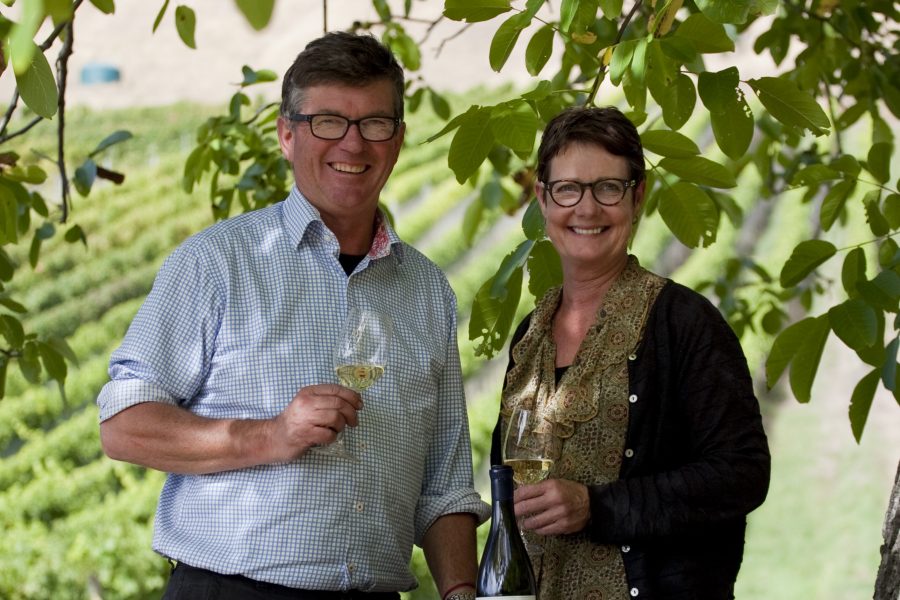
James and Annie Millton. Bob Campbell MW
James Millton, organic godfather and founder of Millton Vineyards and Winery, Gisborne.
Bob Campbell MW: You planted the country’s first organic vineyard. When was that and what made you do it?
James Millton: We started our wine business in time for the 1984 harvest. While adopting organic and biodynamic activity from that time we worked with the Integrated Pest Management process as the term organic was not very well understood at the time, in fact ridiculed by the commanding body of the New Zealand industry. Oh! That’s right, in those days there were winemakers and grape-growers, much like cowboys and farmers and I wasn’t allowed to use the word winegrower! How times have changed.
“Quality is no longer about chemical correctness but rather a more voluminous biological expression producing wines of immense interest, enjoyment and drinkability.” – James MilltonBC: To me, your role in the organic and biodynamic wine movement is a major part of your identity and yet you play it down on your website. Are you concerned about being stereotyped as “weird hippies”?
JM: Well, we are very lucky and fortunate to be doing an activity from the beginning of our lives which we really love and get pleasure and enjoyment from. Our website might downplay our nursery rhyme due to the knowledge, I am told, that people seem to spend only a short while on a website such is the power of social media these days. If someone wants to stereotype us, then they should look at themselves first. Afterall, when you point at someone in a critical manner you should not use the index finger as the three other fingers are pointing back towards yourself, exemplifying the negative energy. You may wish to use your open hand instead!
BC: If you discovered that you could increase wine quality by abandoning organic and biodynamic techniques, would you do it?
JM: Without being dogmatic, the short answer is no. Quite frankly, however, the acceptance of biodynamic winegrowing these days by some of the most famous wine estates in the world tells me volumes. Quality is no longer about chemical correctness but rather a more voluminous biological expression producing wines of immense interest, enjoyment and drinkability. To look at increased quality by increasing the science and technology is so last year, like climate change. Much talk, science and bureaucracy yet very little meaningful action. An onward direction would be in mindfulness embracing not only social, environmental and financial sustainability but mostly the cultural, fourth quadrant.
BC: In my view, the word organic adds value to wine but there was a time when it reduced the value of a bottle of time. Can you recall the moment it crossed the line?
JM: We are entitled to our own views. We were one of the first New Zealand producers to sell certified organic wine into the UK in 1989. We are one of the oldest biodynamic winegrowers in the southern hemisphere and within the oldest 10 in the world. We were young, motivated and opinionated, but still young. When Chernobyl occurred our sales increased tenfold. When mad cow disease took hold our sales increased, so we have never looked for the added value. Even these days our wines are conservatively priced, which is taxing, especially when our growing costs can be as much as 30% greater than “chemical practice”.
What is interesting now is that even the corporations are changing somewhat to growing vines organically such is the demand of the gatekeepers from the commodity traders. Thank heavens for the explosion in funky natural wine bars in the hipster centres of the major cities in the world, where people are happy, healthy, and opinionated!.
BC: Should I pay more for a bottle of biodynamically-produced wine than a bottle of conventionally produced wine?
JM: Yes of course, if you value your health, digestion and wellbeing, as well as understanding the profound positive attributes of naturally formed polyphenols and their effect on your blood flow, and ability to think clearly.