


Skip Francis: carpenter to vigneron
 Huon Hooke in Wine People
 Become a member to view this article
The Real Review is editorially independent. We don’t sell wine. We are free of influence from vested interests such as wine producers and sellers, and proprietors with conflicts. We tell you what we think about reviewed wines, served straight up. Our articles cover topics our writers choose because of genuine interest.
We rely on our members to publish The Real Review. Membership provides access to thousands of articles, a growing database of more than 160,000 wine tasting notes, exclusive member discounts and more.
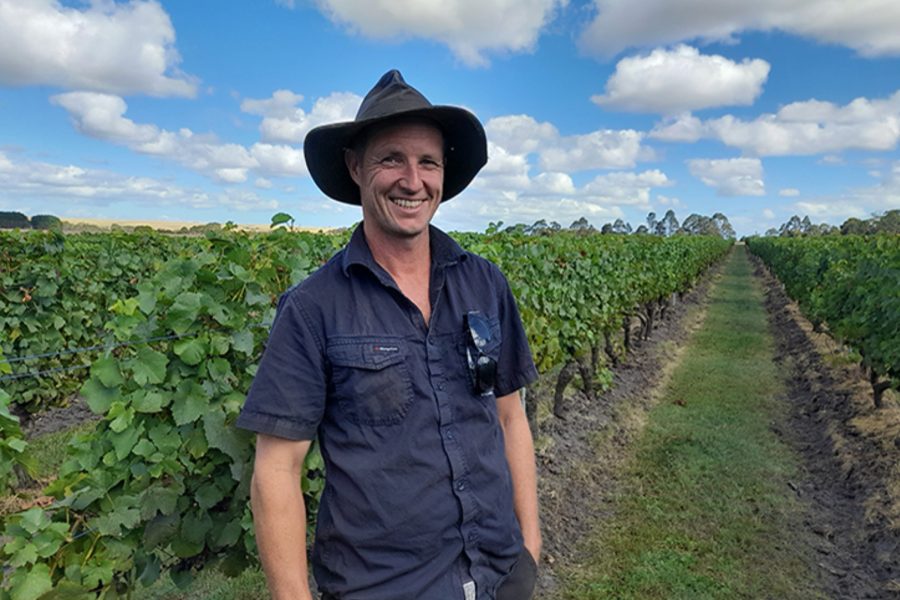
Adam ‘Skip’ Francis in the vineyard. Bass Phillip Wines
Guide to Gippsland Feature Week
Skip Francis is settling into his new career as custodian of Australia’s most famous pinot noir.
In the five years since Bass Phillip was sold by founder Philip Jones to a group including Burgundy winemaker Jean-Marie Fourrier, Francis has pivoted from a carpenter building houses to vigneron. He has his brother-in-law Fourrier looking over his shoulder, but from a far distance. Gevrey-Chambertin to Leongatha is a long way.
In the five years since Bass Phillip was sold by founder Philip Jones to a group including Burgundy winemaker Jean-Marie Fourrier, Francis has pivoted from builder to vigneron.In the interim, former Cape Mentelle chief winemaker John Durham looked after the winemaking. Durham has since retired to the beach. Now Skip is in charge of the vineyard and winemaking. He seems to be well across the job, judging from my visit in August.
Instead of meeting at the original Bass Phillip vineyard and winery we met at the new winery north of Leongatha. The winery is a large iron shed partly filled with barrels of maturing wine. It’s situated beside a new Bass Phillip vineyard named Clair de Lune.
“This site is cooler, higher and wetter than Leongatha and the grapes ripen four weeks later than the Leongatha vineyard, which is 15km away,” says Francis.
“We will knock down the old winery and plant vines there, because it is the Reserve site.”
This seems logical from two viewpoints: the old winery was from all reports not fit for purpose, and secondly, and most importantly, if that winery is sitting on land that would produce pinot noir of the quality needed for Bass Phillip Reserve Pinot Noir, at AUD $850 bottle, knocking it down is a no-brainer.
The Clair de Lune vineyard is already planted with chardonnay and pinot noir, and there is more of both planned, as well as gamay and cabernet franc. There are presently 14 ha under vine, and this will be increased to 18. Wine production is set to be boosted: at present Bass Phillip is crushing about 30 tonnes of grapes and the probable target is 100.
A cynic might observe that the new ownership is planning to leverage the brand to make more wine and more profit. A pragmatist might reply: that sounds like a good idea: make the brand work for you.
We tasted some impressive chardonnays from the barrels, which prompted me to ask Skip if there is a chance we will see a Bass Phillip Reserve Chardonnay in the future? There has never been one to date. “Watch this space,” was his reply.
I had been impressed that vineyards in the humid and damp, cool climate of West Gippsland don’t need to be irrigated. I asked what Jean-Marie Fourrier’s attitude was to both irrigation and acid addition.
“Jean-Marie is against irrigation but he’s not against acid addition. However, he is jealous of the pHs we’ve been getting!”
In other words, the pH of the Bass Phillip grapes is low enough that acid correction is not needed. That said, Francis said phenolic maturity was more important to him than sugar or acid, as an indication of ripeness. To establish phenolic maturity, he chews the skins and crushes the seeds. Brown seeds are what they want.
This is no fancy chateau, no Napa Valley rich man’s edifice. It’s a plain tin shed and the bottling line they will be installing presently is second-hand.
“Jean-Marie is sending his old bottling line over here. So far, we use a contract bottler who brings a truck.”
That must be expensive?
“ I’d rather pay a lot to ship it over here from France than to pay a lot more to buy a new one.”