


Book review: How to Drink Australian by Jane Lopes and Jonathan Ross
 Huon Hooke in Wine Books
 Become a member to view this article
The Real Review is editorially independent. We don’t sell wine. We are free of influence from vested interests such as wine producers and sellers, and proprietors with conflicts. We tell you what we think about reviewed wines, served straight up. Our articles cover topics our writers choose because of genuine interest.
We rely on our members to publish The Real Review. Membership provides access to thousands of articles, a growing database of more than 160,000 wine tasting notes, exclusive member discounts and more.
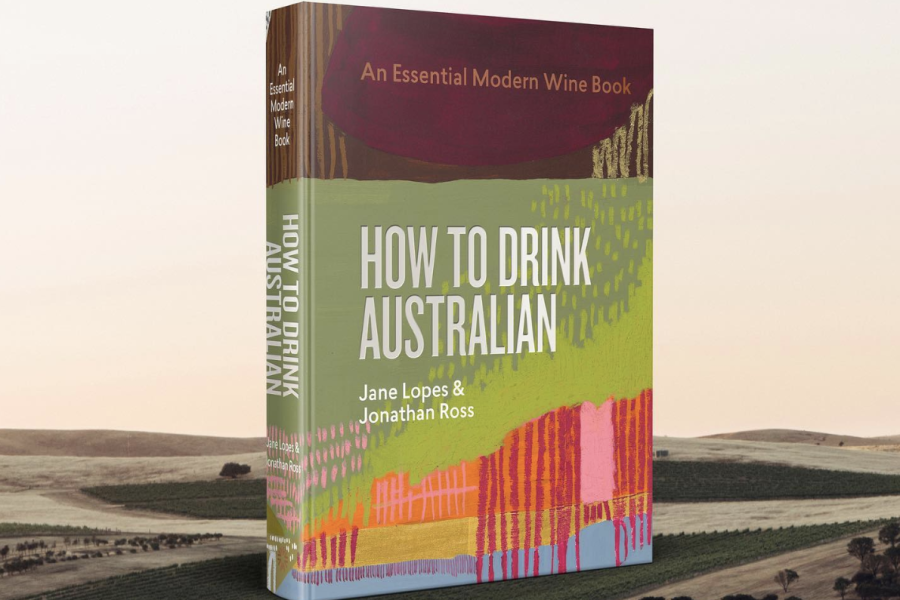
How to Drink Australian has just been released. Auswinelegends Instagram
When I was starting out in the 1970s, eager to know more about wine, the one book everyone had to have was Len Evans’s Complete Book of Australian Wine, published in 1976.
Now we have a book that is today’s equivalent of that important reference work.
This is an outstanding piece of work. If there is one book that anyone wanting to learn more about Australian wine should have, this is it.An outstanding new introductory book on Australian wine has just been released: How to Drink Australian, by sommeliers Jane Lopes and Jonathan Ross. Published by Murdoch Books, it’s a fairly large, hard-backed book of 495 pages, weighs in at 2 kg and costs AUD $80.
There are several other writers who contributed, and the text is superbly augmented with detailed maps by Martin von Wyss, who has previously published glovebox maps of Australian wine regions.
The text traverses the country region by region, is rich in detail about soils, climate, history and people, and within each region profiles a handful of the most prominent producers.
Lopes and Ross are a married couple, both Master Sommeliers, who both worked at New York restaurant Eleven Madison Park. Subsequently, Lopes was wine director at Attica, Melbourne, while Ross was beverage director for the Rockpool group. They now live back in the US where they run an importing business, Legend Imports, which specialises in Australian wines.
Each regional chapter starts with the Introduction that deftly and concisely documents the history of the area, then a section titled Evolution of Wine, all about the region’s development during its history, then Lay of the Land, which predictably focuses on the geography, geology and climate; and finally, Hubbub, which brings us up-to-date with current goings-on in a chatty, almost gossipy way.
Amongst these pages packed with information are the outstanding and very up-to-date maps of Martin von Wyss, as well as fact boxes containing statistics and climate data.
Finally, there are the Producers pages. Inevitably, these are limited by space considerations. The selections tend to feature a high proportion of newer, younger producers, a choice which may vex some readers hunting for their established favourites. Getting the balance right is a tricky thing, and it’s important to back one’s hunches and include some of the people who are likely to be an important part of a region’s future. It’s a good approach. Example: in Margaret River, the 21 producer profiles include Blind Corner, Corymbia, Dormilona, LAS Vino, Si Vintners and Wines of Merritt, but not Fraser Gallop, McHenry Hohnen, Stella Bella or Ashbrook. To be fair, most of those that narrowly missed out are at least mentioned in the ‘And don’t forget…’ column at the end.
After reading several chapters at random I found very little to quarrel with: the depth of knowledge is outstanding and the copy is very readable; the writers are obviously very well informed. A lot of time and research has gone into this book.
The one thing that consistently niggled was the pen drawings of winemakers, which seldom look anything like their subjects! Deserving of support though art is, photographs would have served better. There is also a judicious sprinkling of colour photographs, and the style of the book is enhanced by a matt finish (as opposed to gloss).
This is an outstanding piece of work. If there is one book that anyone wanting to learn more about Australian wine should have, this is it.
And it took two Americans to deliver it!
I do agree this is an excellent book for both novices and experienced wine consumers. Where I think the book overplays its hands is the focus on the more trendy and nouveau wineries which tend to diminish the book. I think the authors do have some strong personal biases that they should declare upfront.
Yes, well, they are sommeliers! Goes with the territory. But it is a difficult job balancing these lists. Do you favour the established, the tried and tested, who have shown they’re in for the long haul, or do you include some newbies who may be gone tomorrow or may turn out to be stayers. And how do you get that balance right? I think they did a reasonable job.