


The Australian Ark wine opus
 Huon Hooke in Wine Books
 Become a member to view this article
The Real Review is editorially independent. We don’t sell wine. We are free of influence from vested interests such as wine producers and sellers, and proprietors with conflicts. We tell you what we think about reviewed wines, served straight up. Our articles cover topics our writers choose because of genuine interest.
We rely on our members to publish The Real Review. Membership provides access to thousands of articles, a growing database of more than 160,000 wine tasting notes, exclusive member discounts and more.

Andrew Caillard MW. The Australian Ark
Let me state from the outset: I am in awe of what my friend Andrew Caillard MW has achieved with his three-volume opus, The Australian Ark.
I now understand why I seldom see him.
It is simply the most comprehensive and detailed history of wine in Australia that has ever been written, by a wide margin.He’s been working on this massive task—on and off—for nearly 20 years, and the three-volume set runs to more than 350,000 words.
It is simply the most comprehensive and detailed history of wine in Australia that has ever been written, by a wide margin.
It’s doubtful whether any other country outside the ‘Old World’ has anything comparable.
Caillard is a master of wine, a wine writer, author of many other books, taster, former wine auctioneer, sometime wine producer, and all-round wine expert, but the writing is just one part of this audacious work. What takes the breath away immediately upon picking it up, is the quality of the production and the beauty of the presentation. The range and depth of photographs and illustrations is striking and the look of the books is sumptuous. Tens of thousands of dollars were paid in publishing rights alone.
These volumes constitute a work of art in themselves and this is no surprise as Caillard has a well-developed aesthetic sense. He is an accomplished painter into the bargain (and some of his canvases appear in the Ark).
That the author has a powerful sense of history is everywhere apparent. Although he was not born in Australia his mother was Australian and his forebears include the Reynell family who established Chateau Reynella in McLaren Vale. The Reynell family died out, no thanks to tragic war casualties, but the name lives on, in the wine and in the name of the Reynell selection of cabernet sauvignon vines that is particularly prized in South Australia.
It would be presumptuous to attempt a proper review of this work without reading all or most of it. Like most readers, I suspect, I’ve been grazing (rather than bingeing) on it over recent weeks. It’s rather like browsing the internet: you look up something specific, and an hour later you realise you’ve spent that hour reading, and been totally engrossed. In fact, the Ark can be used as either a reference work or a full-on read.
The Ark comes in a boxed set and is available in three forms: softback (in a plastic box), cloth-bound hard-back (in a cloth-bound box) or leather-bound. Prices are AUD $199, AUD $399 and AUD $999.
- Volume 1 covers 1788–1900: The Colonial Era
- Volume 2 covers 1901-1983: Federation to the Modern Era
- Volume 3 covers 1983–present day: Contemporary Times, Recollections and Perspectives.
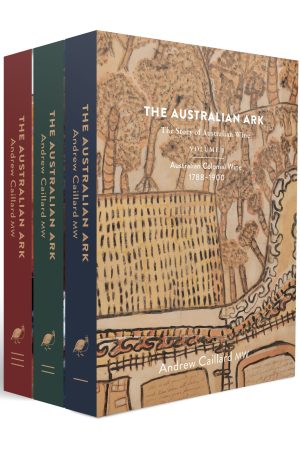
The Australian Ark volumes. The Australian Ark
The scope of the Ark is all-encompassing. It covers trends in viticulture, winemaking, wine science, the market and the development of wine regions. It details the history of many of the leading wineries, and their prominent wines. It talks about notable wine personalities, noteworthy events, the wine commentariat… few stones are left unturned. It deals in an up-to-date way with the colonisation of Australia and what that meant for the indigenous population, and how the wine industry interacted with the original Australians.
Most of this we might expect in such a grand history, but there are many other inclusions that are a bonus. Lists are scattered throughout—of grapevine importations, of notable Roseworthy graduates, of wines shown at early European exhibitions. The memorabilia from the Macarthurs and Camden Park is extensive. Early pictures and photos are highly evocative of early times: photos such as the building of the Gnadenberg church and the All Saints castle, the Tahbilk winery in the 1880s and many 19th century working pictures at Best’s, for example. And many fine paintings, such as Hans Heysen’s of Pewsey Vale.
Tables include:
-Australian Vinestock Transmission 1788-2023 which lists the grape varieties in use, who first imported them and when.
-Australia’s Surviving Old Vine Plantings ca 1843 – 1952. This astonishing list runs to 13 pages. It begins with Langmeil’s 1943 Freedom Vineyard shiraz, and declares that Australia has the largest area of surviving 19th and early 20th century grapevine plantings in the world.
This is truly a treasure not only for the wine industry but for any wine lover with an interest in history.
*Latest news: The Australian Ark will be offered for sale through the French-based wine trading company La Place de Bordeaux.
I have completed reading the first volume and am now into the second. What a mesmerising experience. It takes you through the beginnings of Australian agriculture and the individuals who shaped our growth. What I have been stunned to learn is how early the premium regions for the vine were identified and developed in the mid 1800’s. How much we owe those families is hard to measure and how remarkable that many have continued in one form or another. As for Benno Seppelt’s decision to lay down port for 100 years knowing he would never taste it, what an extraordinary initiative. I had great expectations of what I would learn, and these have been exceeded many times over. I concur with all your comments, Huon, and thank Andrew for enriching the Australian wine industry and wine enthusiasts like me. Essential reading for anyone who loves Australian wine.