


Exploring Australia’s best shiraz regions
 Huon Hooke in Regional Spotlights
 Become a member to view this article
The Real Review is editorially independent. We don’t sell wine. We are free of influence from vested interests such as wine producers and sellers, and proprietors with conflicts. We tell you what we think about reviewed wines, served straight up. Our articles cover topics our writers choose because of genuine interest.
We rely on our members to publish The Real Review. Membership provides access to thousands of articles, a growing database of more than 160,000 wine tasting notes, exclusive member discounts and more.
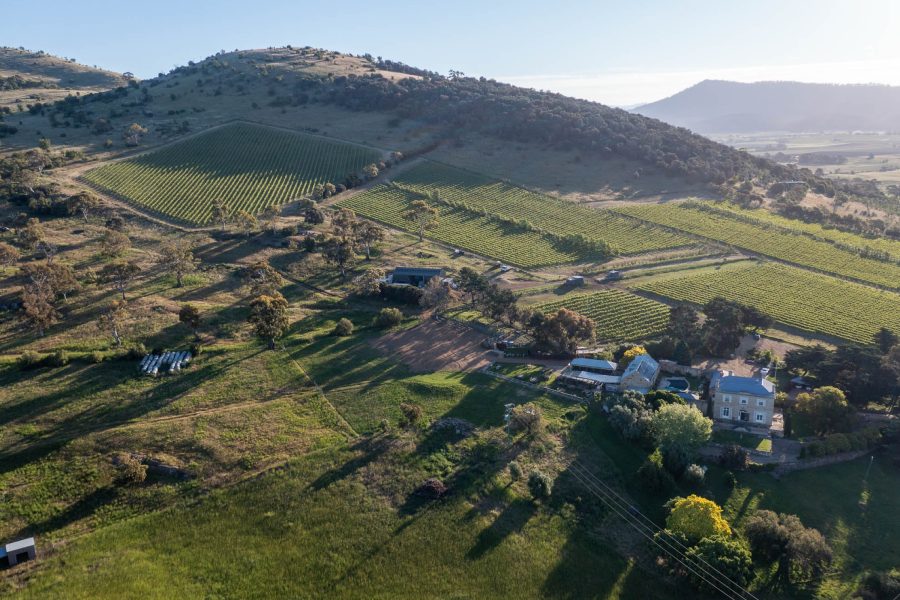
Vineyards in Tasmania’s Coal River Valley. Pooley Wines
Guide to Shiraz/Syrah Feature Week
So, you don’t like shiraz?!
But, what kind of shiraz don’t you like?
The variation in shiraz taste is more a factor of climate than soil or geology.At my last count there were 40 regions in Australia that regularly produce excellent shiraz red wines. That includes the majority of the 65 gazetted GI (Geographical Indications) regions. The 65 doesn’t reflect the several distinct regions in Tasmania, as the entire state is counted as one GI. Tasmania produces fine shiraz in the Tamar Valley, Coal River Valley, the East Coast, and probably other places.
Most, if not all, Australian wine regions grow some shiraz.
To suppose that 40 regions all produce shiraz that tastes the same would be illogical. The Canberra District wine region’s slogan is “Wine is liquid geography”, which goes to the heart of the matter.
Geography deeply influences the way wine tastes. We could list the main natural factors as altitude, latitude, proximity to the ocean, geology and mesoclimate (temperature, insolation, rainfall, wind, etc), never mind the human-controlled factors such as viticultural methods and vine stock selection.
The variation in shiraz taste is more a factor of climate than soil or geology. To generalise, the cooler the climate the lighter the wine in colour, body and tannin. Cooler climate shiraz is more aromatic, with aromas of red fruits, pepper and other spices, while the hotter the climate the less spicy, and the more it’s about black fruits, chocolate/mocha and earthy, meaty savouriness. Warm climate shiraz also tends to be richer, sweeter in fruit flavour (not to be confused with residual sugar) and can carry a higher level of alcohol without losing its balance. The heartier the shiraz, the bolder the food flavours it can partner.
The pleasure our shiraz gives people in all corners of the world map can be overlooked in the deluge of bad publicity.Despite the gloomy news regarding Australia’s over-supply of grapes, especially shiraz, the world loves shiraz and continues to drink and enjoy a great deal of it. The pleasure our shiraz gives people in all corners of the world map can be overlooked in the deluge of bad publicity. There is simply an imbalance of supply and demand. Meanwhile, you and I will continue to enjoy a glass—regularly.
Below I list my 25 top shiraz regions, in alphabetical order within their states.
New South Wales
South Australia
- Adelaide Hills
- Barossa Valley
- Clare Valley
- Coonawarra
- Eden Valley
- Langhorne Creek
- McLaren Vale
- Wrattonbully
Victoria
Western Australia
Tasmania
Coal River Valley, East Coast, Tamar Valley
The second tier: those 15 regions that are capable of excellent shiraz, but with either less consistency or shorter track-record.
- NSW- Gundagai
- SA – Padthaway, Southern Fleurieu, Southern Flinders Ranges
- VIC –Alpine Valleys, Glenrowan, King Valley, Mornington Peninsula, Rutherglen, Strathbogie Ranges
- WA – Geographe, Peel, Perth Hills, Swan District
- QLD – Granite Belt