


A Thousand Gods: part two
 Stephen Wong MW in Winery Spotlights
 Become a member to view this article
The Real Review is editorially independent. We don’t sell wine. We are free of influence from vested interests such as wine producers and sellers, and proprietors with conflicts. We tell you what we think about reviewed wines, served straight up. Our articles cover topics our writers choose because of genuine interest.
We rely on our members to publish The Real Review. Membership provides access to thousands of articles, a growing database of more than 160,000 wine tasting notes, exclusive member discounts and more.
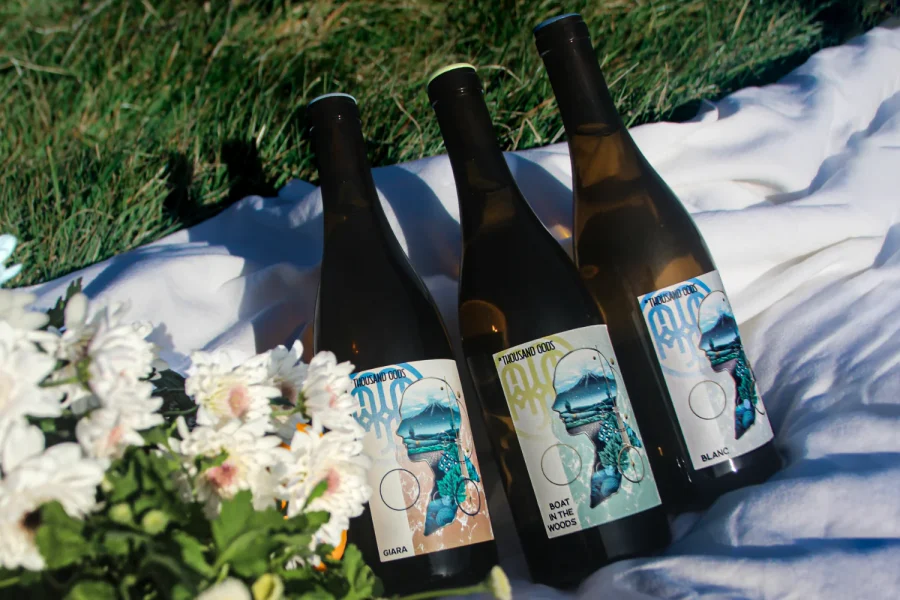
Some of the A Thousand Gods wine range. A Thousand Gods Wines
*This is a continuation from last week’s piece, which can be found here.
When last we left Simon Sharpe, he had found himself back in Marlborough for vintage, leaving his wife and young son back in France, as COVID rapidly swept across the globe. With international travel shut down and New Zealand’s borders closed, he hunkered down with the rest of the the country in the relative safety of the South Island (which remained COVID-free).
A Thousand Gods would be made at The Coterie for its first three years before Simon and Lauren decided to bring it closer to home and truck the fruit from Churton down to Canterbury.When the national lockdown lifted, Simon raced back to Cahors to get his family and they migrated back to New Zealand in the midst of tight border controls and quarantines. International travel at that time was surreal and spooky as massive airports echoed with the sound of silence and emptiness. It was a challenging time to move half-way across the world, but it was worth it for them to be back in Aotearoa and because of the immense potential which awaited them with A Thousand Gods.
Simon made just the one wine in 2019, which was simply called Sauvignon Blanc (it was 100% sauvignon blanc from Churton Vineyard). Because he was still living in France at the time, he did not get to taste the wine regularly during its evolution, like one normally would in a winery. But when he returned in 2020 and saw the wine again after nearly a year of ageing at The Coterie, it affirmed everything they had risked and put on the line. In fact, it exceeded all of his expectations and the 2019 Blanc is spectacular—even now, nearly six years later.
The young family settled down in Christchurch and continued making their wine at The Coterie in 2021. The fruit which they received and continue to receive from Churton is at the heart of the project. The biodynamic farming, care and attention in the vineyard meant that it was possible for Simon and Lauren to make ‘fully natural wine’ without any additions or adjustments while also having the confidence that the wine will be stable and ageworthy, like the best examples they had come to love in France.
Credit must also be given to Sam Weaver’s foresight in planting that hillside site at a time when most plantings were on easier land to work lower down. Additionally, many thought Weaver was crazy to plant what he did. Instead of the MS (UCD 1) clone, which dominates plantings of sauvignon blanc in Marlborough, he planted Bordeaux clones.
With Simon’s background in wine science and more specifically sauvignon blanc aromatic compounds (refer to part one for that history), he knew he could make a completely different kind of wine from this fruit. The fruit had more terpenes rather than thiols and methoxypyrazines. Although terpenes also change with time, they don’t degrade as quickly and traditionally get more honeyed while having better stability over the long term (terpenes are responsible for the aromatic development of riesling, albariño and chenin blanc, for instance).
A Thousand Gods would be made at The Coterie for its first three years before Simon and Lauren decided to bring it closer to home and truck the fruit from Churton down to Canterbury. In 2022, they made the wine at Greystone in Waipara but now have their own urban winery (which they live above) in Rolleston. The industrial zone there is a far cry from the idyllic Occitanie which they left behind, but the strength of their conviction has borne fruit in the quality of their wines.
The relationship with Churton is incredibly strong. To the best of their knowledge, they are the only winery to use all four varieties from Churton: sauvignon blanc, pinot noir, viognier and the incredible, rare petit manseng. From these four varieties, they make a wide range, from sparkling through to skin-fermented. All the wines adhere to the same philosophy, which relies entirely on what comes from the vineyard with no additions.
Their Java sparkling wines, which are made in the style of pétillant naturel, are not actually bottled during primary ferment. They are closer in technique to the ‘new school’ of pét nat which has evolved in Europe over time and utilises a stable, dry base wine to which they add unfermented juice from the following vintage. When this starts to ferment, they bottle the wine and complete the fermentation in the bottle, resulting in a lower pressure, in line with pét nat effervescence. Their first vintage of Java was filtered, but the wine appears more stable without filtration so they no longer filter their sparkling wines. They don’t disgorge them either.
For stability, Simon and Lauren rely on malolactic fermentation and slow ageing in old oak barrels without sulfur, which they find helps to eliminate volatile compounds which might develop in bottle otherwise. They are also allowed to become stable in this environment so that they are more resilient in bottle.
The project continues to evolve and grow, but the wines being made at A Thousand Gods are very good and very singular.The Real Review has highlighted two of their wines before, the Love Letters and Blanc. The former is a Pfifferling Tavel-like style made predominantly from pinot noir which is pressed off its skins at a stage between a traditional rosé and a red wine. The Blanc is the new name for the wine previously known as Sauvignon Blanc but is essentially the same wine as the 2019, which started everything. They also make another wine from sauvignon blanc called Giare, which is fermented and aged in a large giare (clay ‘amphora’) which was a gift from Simon’s old boss at Mas del Perie, which was used to age chenin blanc back in Cahors.
A Thousand Gods also make a fascinating light pinot noir called Flos: a name Lauren came up with, which means flower, or the best part of. That fruit is from Churton’s challenging Abyss block and has a tendency to be hard and firm but is spectacular quality. They had to learn how to be very gentle with it to allow all of its delicacy to express itself.
The project continues to evolve and grow, but the wines being made at A Thousand Gods are very good and very singular. The incorporation of techniques from the natural wine world with the technical training and scientific background which they each gained in their formative years has allowed them to carve out a path entirely their own in Marlborough, the home of sauvignon blanc.