


A special visit to Quinta da Pacheca
 Huon Hooke in Free for all
 Become a member to view this article
The Real Review is editorially independent. We don’t sell wine. We are free of influence from vested interests such as wine producers and sellers, and proprietors with conflicts. We tell you what we think about reviewed wines, served straight up. Our articles cover topics our writers choose because of genuine interest.
We rely on our members to publish The Real Review. Membership provides access to thousands of articles, a growing database of more than 160,000 wine tasting notes, exclusive member discounts and more.
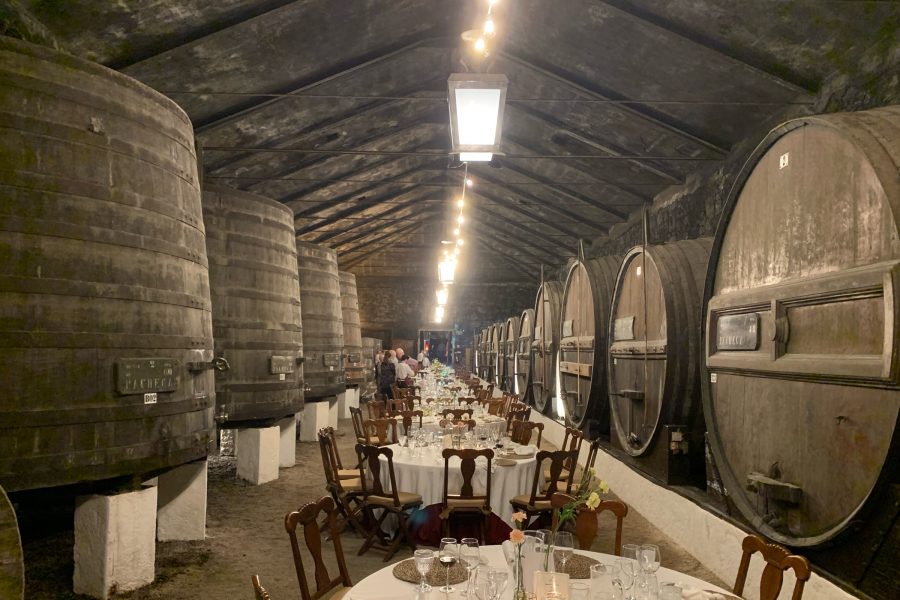
Dinner among the oak vats and massive barrels at Quinta da Pacheca. Huon Hooke
The one-week river cruise on Portugal’s Douro River was not intended to be work, but hey: you can’t send me on a trip through a vineyard area as exciting as the Douro and expect me to go cold turkey.
Pacheca is a highly professional business located on a property which dates back to 1738 in name, and even earlier as an actual farm.So it was that I found myself with a shipload of 120 people at Quinta da Pacheca, near Lamego in the heart of the port-wine country. One evening, the SS São Gabriel docked in Lamego and off we went by bus to dinner.
Pacheca is a highly professional business located on a property which dates back to 1738 in name, and even earlier as an actual farm. This is even before the Douro DOC (Controlled Denomination of Origin), the world’s first appellation control system, was created—in 1758.
It’s 40 years since my only other visit to this spectacular and remote vineyard region, so I was especially excited. At the entrance to the winery (a quinta is a winery, a farm or just any property) stood an ancient olive tree, 1200 years old according to our guide, and not even the oldest in Portugal. It still produces olives and appears in perfect health.
On entering the fermentation cellar I was amazed and thrilled to see a large room filled with lagares. These are wide, shallow stone troughs built of gleaming white granite, in which the grapes are fermented. Pacheca has eight of them. During the vintage, workers link arms and form a chain, and walk back and forth from one end of the lagar to the other, stamping the grapes as they go to break their skins and release the juice.
This is the traditional way to produce port, but it fell out of popularity in the last half of the last century partly because of the lack of manpower: people were leaving the rural life for the cities, an exodus that still continues, starving the port vineyards of people-power. Also, new fermentation methods that did not rely on people had been invented: stainless steel tanks with automatic pump-over and pigeage systems to macerate the fermenting grapes. However, traditionalists always maintained that lagares produced the best result.
Our group was given a brief tour and explanation of the winery, then went down to the barrel hall for an excellent dinner among the oak vats and massive barrels. The walls of this cellar are thick with black mould such as you find in many cellars in Champagne, Burgundy and the Rhône. It all adds to the atmosphere.
We finished with Pacheca 30 year old Tawny, which was quite exquisite.The Pacheca Superior white 2023 and red 2022 were the best wines so far on the tour (granted, wines served on the ship as part of a tour package should never be expected to be the highest level!). The white was barrel fermented and blended from viosinho, gouveio, códega do larinho, arinto, and códega; the red from touriga franca, touriga nacional, tinta roriz (tempranillo), tinta barroca, and sousão. And yes, Portugal has one of the largest collections of indigenous vines of any country.
We finished with Pacheca 30 year old Tawny, which was quite exquisite.
I later drank the Pacheca Tinto 2022 regular bottling, and also found it of very good quality if not as distinguished as the Tinto Superior ‘22.
Quinta da Pacheca may be an ancient name but it has only quite recently opened its doors to the public and become a tourist destination—in 1995 to be precise. It opened its hotel, The Wine House Hotel Quinta da Pacheca, in 2009. It has 75 hectares of vines and is evidently focused on table wines as much as fortified.
It is well worth a visit.
(Continued tomorrow)