


Keith Tulloch plans for the future
 Huon Hooke in Winery Spotlights
 Become a member to view this article
The Real Review is editorially independent. We don’t sell wine. We are free of influence from vested interests such as wine producers and sellers, and proprietors with conflicts. We tell you what we think about reviewed wines, served straight up. Our articles cover topics our writers choose because of genuine interest.
We rely on our members to publish The Real Review. Membership provides access to thousands of articles, a growing database of more than 160,000 wine tasting notes, exclusive member discounts and more.
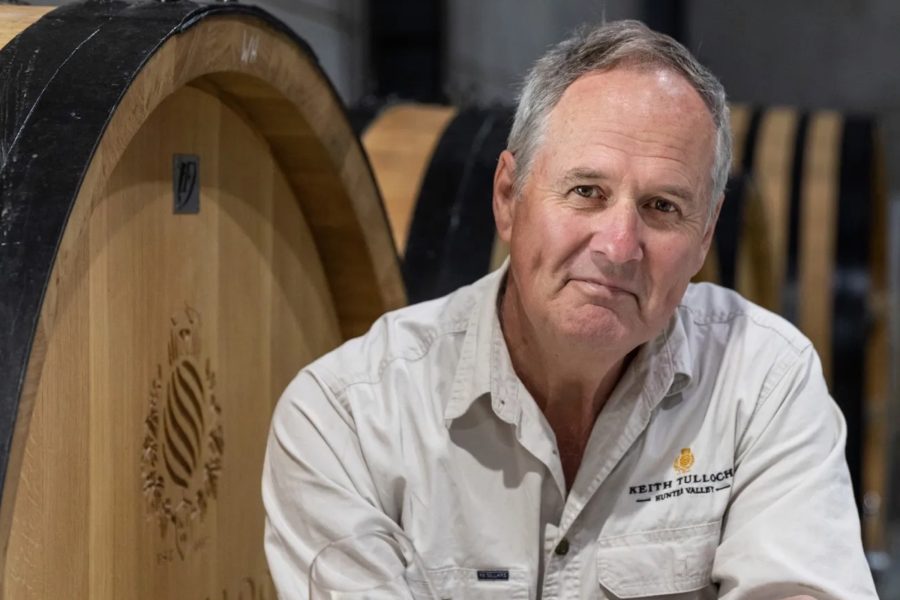
Keith Tulloch has no plans to retire but will be taking more of a back seat. Tulloch Wines
There have been big changes at the Hunter Valley’s Keith Tulloch Wines.
The Hermitage Road property, with the Field of Mars vineyard and winery and cellar door buildings, was sold in 2023 to Chinese interests, while Keith and his wife Amanda and family retain ownership of their Latara vineyard property, brand, company, wine stocks and equipment. The land and buildings are leased back to the Tullochs and they have the right to continue to use them. The buyer, Sun Investments, has also bought the Casuarina property next door.
“We are wine people for life. We can’t imagine doing anything else.” – Keith TullochKeith and Amanda have lodged a development application with Cessnock Council for a new development on their Latara property, which occupies a plumb position on the corner of McDonald’s Road and Deasy’s Road, Pokolbin. This 12ha property has excellent potential for business development, Keith says.
Keith Tulloch comes from a distinguished line of Hunter wine people. One of his first jobs after graduating from wine college was as Len Evans’s winemaker at the Evans Wine Company. He and Amanda started KTW 25 years ago and built on the existing site 15 years ago. They’ve no plans to retire but will be taking more of a back seat in the future.
“We are wine people for life. We can’t imagine doing anything else,” says Keith.
Their son Alisdair has his own wine brand, Aeon Wines, and is developing a vineyard in the Huon Valley in southern Tasmania. To date he has released three Hunter Valley red wines under the Aeon label: a syrah, a syrah pinot noir blend and a syrah touriga viognier blend (the word syrah is used for shiraz on all of them).
The Tasmanian property has been planted to pinot noir and shiraz, on 1m x 1m spacing, and a first crop is expected in 2026.
“We were hoping for a 2025 vintage, but it turns out that vines are slower growing in Tasmania than in the Hunter,” says Keith.
Daughter Jess and her husband Ben Whittemore-Tulloch have a distillery at the KTW winery. Ben is a distiller and produces shiraz gin, chardonnay gin and semillon gin under the FAR brand (it stands for Forage And Roam). Their first shiraz gin won a gold medal at the Melbourne spirits show.
“The new development will incorporate all of that,” says Keith. “Three parts of a circle. It will be diverse, focusing on much more than just KTW”.
Meanwhile, it will be business as usual at Keith Tulloch Wines.
A memorable dinner was held in Sydney recently to salute Keith and Amanda’s achievements at this watershed time in their lives.
Friends and long-time customers Peter and Judi Dazeley raided their cellar for the dinner wines: a bracket of semillons, then one of chardonnays, and two brackets of shiraz.
- Keith Tulloch Field of Mars Block 2A Semillon 2017 and 2013 and regular Semillon 2011
- Keith Tulloch Field of Mars Chardonnay 2017, 2016 and 2013
- Keith Tulloch Kester Shiraz 2014, 2010 and 2003
- Keith Tulloch Field of Mars Shiraz 2011 and 2017
It was a spectacular lineup which amply demonstrated how Hunter Valley wines of all three varieties age superbly and reward careful cellaring.
The 2011 Field of Mars Shiraz was the star in a consistently excellent group of shiraz, a powerful, robust and character-filled red that will power on for many more years.
In the Kester Shiraz group, the 2014 was the stand-out, with power and concentration, while the 2010 was perhaps more typical Hunter: medium bodied, elegant and beautiful, and very regional in its aroma and flavour. The ’03, while showing some of the hot-year characteristics of the vintage, had nevertheless also aged well.
The semillons were gorgeous. The 2017 was wonderfully fragrant and fresh with just a lacing of toast and promising to go for another decade; the 2013 was scored at the same high level but was a quite different style: delicate, mineral, seriously refined and also promising at least another decade of enjoyment. The regular estate wine from 2011 was a fuller, richer wine and drinking at its peak, with a shorter lifespan than the Field of Mars bottlings—but there’s no great hurry to drink it.
From the best vintages, these wines are capable of long-term aging, 20 years for semillon and 20 and more for shiraz.Chardonnay in the Hunter is perhaps the least renowned of the three for its cellaring potential, but this is a misconception. Field of Mars Chardonnay, along with Tyrrell’s Vat 47, Lake’s Folly and a few others, has runs on the board for longevity. The 2017 and 2016 were both glorious wines of great flavour, concentration and elegance, the 2016 having a little more of the smoked-charcuterie flinty reductive character than the others. The 2013 was the least of the trio but still a good wine, drinking well but not recommended for further cellaring. Ten years is a good age to be drinking top Hunter chardonnay.
Shiraz and semillon? From the best vintages, these wines are capable of long-term aging, 20 years for semillon and 20 and more for shiraz.
If only we could be confident that future generations will value cellaring and enjoying aged wines as do previous generations!