


The Hundred Hills experience
 Anthony Rose in Winery Spotlights
 Become a member to view this article
The Real Review is editorially independent. We don’t sell wine. We are free of influence from vested interests such as wine producers and sellers, and proprietors with conflicts. We tell you what we think about reviewed wines, served straight up. Our articles cover topics our writers choose because of genuine interest.
We rely on our members to publish The Real Review. Membership provides access to thousands of articles, a growing database of more than 160,000 wine tasting notes, exclusive member discounts and more.
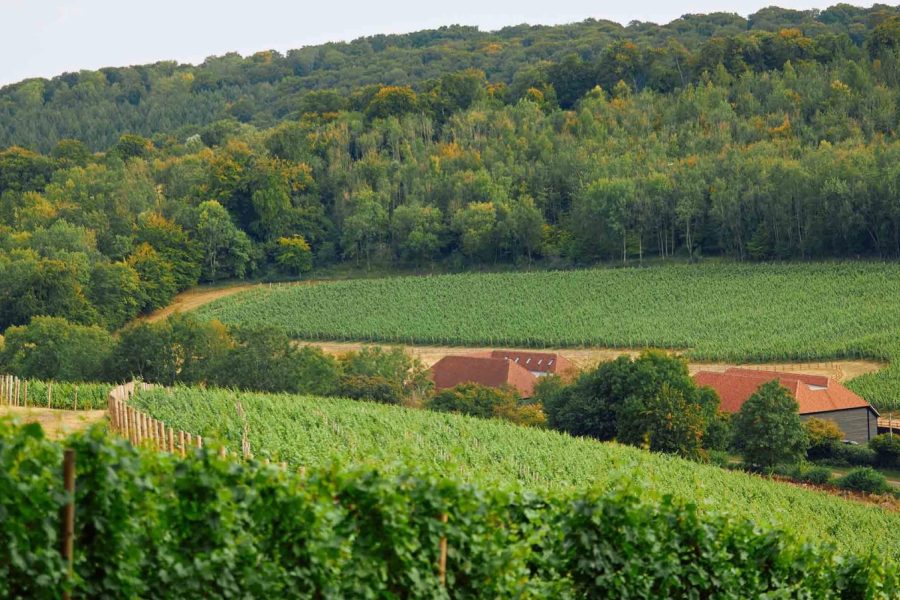
The Hundred Hills estate in Oxfordshire. Hundred Hills Wines
Guide to Champagne & Sparkling Feature Week
When I asked Stephen Duckett of Oxfordshire vineyard Hundred Hills if he would submit samples to The Real Review Top Wineries of Great Britain 2024, he politely declined, saying “Blind tastings, both philosophically and commercially, don’t really relate to our business.”
Almost all of their wines sell directly to visitors who have toured the vineyard, explored the winery, and tasted with the team. For him, wine is inseparable from the stories and emotions woven into the experience.
“Today you have to create a direct experience in a noisy market. People who come here become our natural ambassadors.” – Stephen DuckettIf the mountain wouldn’t come to Mahomet, then Mahomet (disguised as myself) would have to go to Hundred Hills. The estate is named not for a literal count of hills but for the medieval Pyrton Hundred in Oxfordshire’s Stonor Valley. Its vineyard amphitheatre is ringed by a high deer fence, bluebells and ancient beech and oak woodland with views across the valley. So that you feel the land and the way each parcel expresses itself differently according to the season, he will march you up to the top of the hill—and march you down again.
The genesis of Hundred Hills lay in a blind tasting of Nyetimber’s 1992 sparkling wine. Stephen and his wife Fiona were astonished. Stephen, an Oxford graduate with a Fulbright MBA from Harvard, had built technology businesses in Europe and the US. Fiona, whom he had met at Hertford College, had studied French and Russian before completing a PhD on language acquisition. Inspired, they resolved in 2000 to make high-quality English sparkling wine.
Stephen’s research quickly led to the importance of climate and soil. Oxford studies showed England’s growing season had warmed by 2°C since the 1970s. With soils akin to Champagne in many regions, he sought the expert guidance of Dr Michel Salgues, a Champenois who had established Roederer Estate in California’s cool Anderson Valley in Mendocino County.
“Fiona called him up out of the blue and charmed him with her fluent French,” says Stephen.
From 2009, Salgues helped the Ducketts survey potential sites, seeking chalk valleys with airflow, drainage, and frost protection. After examining 300 locations and narrowing the choice down to 100, they chose Bank Farm, once owned by royal photographer Norman Parkinson. Six miles north of Henley-on-Thames, the property is based in a naturally dry chalk valley with substantial aquifers. Samples sent to Champagne were so close in composition that the Comité Champagne asked which part of the Côte des Blancs they had come from.
With Burgundian clones supplied by Pierre Marie Guillaume, and guidance from the champenois viticulturist, Frank Mazy, 60,000 vines were planted in 2014 and 26,000 more the following year. The 17-ha vineyard required no irrigation, with cuttings mulched back into the soil to maintain fertility. Designed to be carbon neutral, it was complemented in 2016 by a Chiltern barn-style winery built by local architects.
“The key starts with the vine,” Stephen explains.
“It has to struggle, so the energy goes into the fruit, not the canopy.”
Chalk soils with low potassium and nitrogen provide just that struggle. The vineyard team strips leaves to keep mildew at bay, uses grass cover for water management, and relies on orange oil, sulphur, and minimal copper rather than herbicides.
Yields average six tonnes per hectare, with vines spaced densely to encourage quality. With protection from wind but good ventilation, precision management—removing underripe second buds, controlling grape moth, encouraging airflow—ensures only the best fruit reaches the press. The vineyard is a menagerie, the deer fence does its job, but pheasants and squirrels are more of a nuisance, while hares, badgers and birds don’t seem to affect the vineyard.
Two 4-tonne Coquard presses handle the harvest of around 100 tonnes annually. The juice is settled, then fermented parcel by parcel in stainless steel, large French oak vats, or barriques, depending on variety and style. More chardonnay sees oak than pinot, with bâtonnage adding richness. Malolactic fermentation may or may not be used, depending on the year.
The wines spend at least 30 months on lees, often longer, and another nine months in bottle before release. Stephen won’t grow meunier, seeing it as high yielding and short-lived compared to chardonnay and pinot noir. Production reaches about 80,000 bottles, with 50,000 reserved for the Hundred Hills label and the rest going into second wines and private collaborations, including with Christ Church College, Oxford.
Rather than saturate retail shelves, Hundred Hills is built on direct experience. Visits are limited to private events, supported by two clubs: Friends of Hundred Hills, and the Hundred Club, an exclusive group of 100 enthusiasts who invest £20,000 each to take part in tastings, events, and creating cuvées. The rest of the wines find their way onto the lists of restaurants such as Le Manoir aux Quat’Saisons, The Fat Duck, Hélène Darroze and Michelin star newcomer, Lita in Marylebone.
“We’re building a boutique, hand-sold brand,” Stephen says.
“Today you have to create a direct experience in a noisy market. People who come here become our natural ambassadors.”
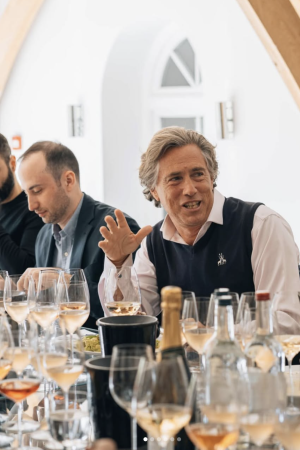
Stephen Duckett of Hundred Hills. Hundred Hills Instagram
He describes the wines as “wine first, sparkling second”—fresh, lively, and designed to pair with food as naturally as still wines. Stephen is convinced traditional loyalties to Champagne houses are eroding.
“Non-vintage is a 19th-century strategy,” he argues.
“The new generations want change and novelty. They don’t trust big brands. Their trust comes from experiencing it themselves.”
For Hundred Hills, that shift is an opportunity.
The vineyard is very much a family business. Stephen and Fiona’s eldest daughter Amy manages sales and marketing, creating her own demi-sec cuvée, Doe-Eyed Queen. Lauren has also worked in the vineyard and winery. Together with a young, dedicated team led by vineyard manager Enrico from Piemonte, the Ducketts aim to keep reinvesting profits to improve year on year. For Stephen, the journey is the reward.
“I’m not planning to retire in my lifetime,” he smiles.
Despite his initial reservations, Stephen did submit his wines for The Real Review Top Wineries of Great Britain 2025, shooting in at number six for the first time.