


Renzaglia Wines champion the Central Ranges
 Aaron Brasher in Free for all
 Become a member to view this article
The Real Review is editorially independent. We don’t sell wine. We are free of influence from vested interests such as wine producers and sellers, and proprietors with conflicts. We tell you what we think about reviewed wines, served straight up. Our articles cover topics our writers choose because of genuine interest.
We rely on our members to publish The Real Review. Membership provides access to thousands of articles, a growing database of more than 160,000 wine tasting notes, exclusive member discounts and more.
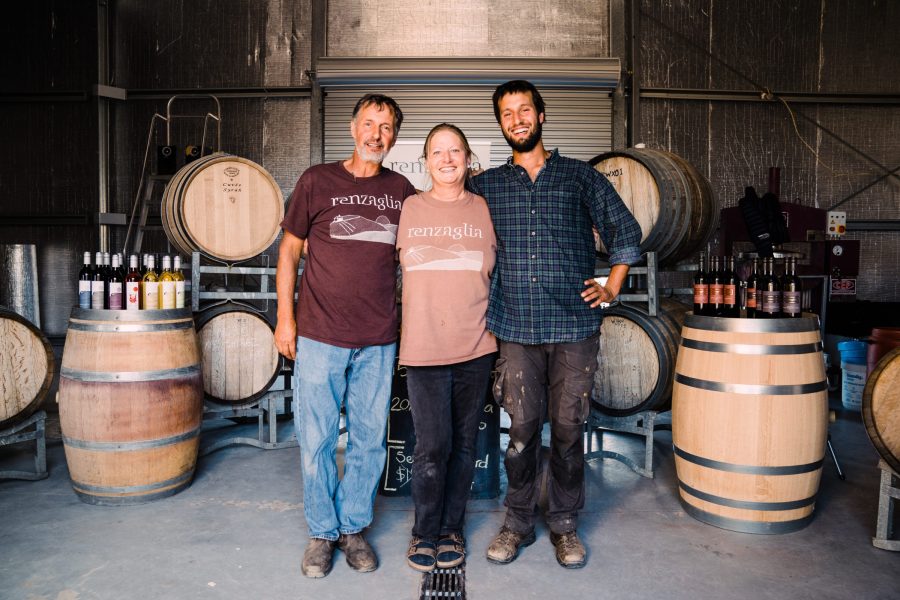
The Renzaglia family (L-R) Mark, Sandy and Sam. Renzaglia Wines
Renzaglia is likely to be a name that you haven’t come across when it comes to Australian wine. I hadn’t discovered them until I judged in the Sydney Royal Wine Show last year with third generation winemaker Sam Renzaglia.
I did have to admit to Sam that I hadn’t heard of his wines (or his location), but welcomed the stories around the history of the winery as well as getting an understanding of their reason for being.
Sam has now taken the winemaking helm and he’s tapped into the diversity and quality of the fruit from across the Central Ranges.The Renzaglia Wines story began in 1982, in the unlikely site of Alto Pass in Illinois USA. Guy and Betty Renzaglia planted a small vineyard and some 15 years later their son Mark and his Australian wife Sandy established their label in the Wambuul Valley, around 25 km south-east of Bathurst in the cool climate Central Ranges of NSW. Mark had completed an advanced diploma in viticulture at Charles Sturt University and wanted to challenge himself around a viticultural location, just as his parents had done, when they planted in Illinois.
Sam has now taken the winemaking helm and he’s tapped into the diversity and quality of the fruit from across the Central Ranges. Sam is exploring vineyards spanning Wallington in Canowindra, Patina and ChaLou in Orange and First Ridge in Mudgee.
In the winery, Sam’s approach is to be respectful of each variety and its origins. He aims to:
“Capture their inherent character without interference, which means no added yeast, tannin, sugar, or acid. We’re using very little new oak and instead working with an array of fermentation and maturation vessels: concrete, earthenware amphorae, stainless steel, foudre, puncheons, barriques and even glass.”
The Renzaglia Central Ranges Riesling 2024 was sourced from the Patina Vineyard in Orange, at over 900m altitude on the rich volcanic soils of Mt Canobolas. The wine was fermented in amphorae and spent 16 months on full lees. There’s lovely tension, cut and thrust here, with pithy and punchy acidity delivering line, length and precision.
The Renzaglia Central Ranges Chardonnay was also sourced from the Patina Vineyard and went through full malolactic fermentation and is oak free—concrete cubes were the fermentation and maturation vessels utilised, the wine staying on full lees for 10 months. There’s plenty of peachy chardonnay charm here, along with a creaminess and nuttiness, all kept in shape by snappy acidity.
The pinot noir was also sourced from the Patina Vineyard. Renzaglia Central Ranges Pinot Noir 2024 has a lovely suppleness and red fruit drive, with an earthy woodsiness and plenty of texture and mouth-feel.
Sam headed to Mudgee for sangiovese, sourced from First Ridge Vineyard, one of the early adopters of the variety in the region. Renzaglia Central Ranges Sangiovese 2024 shows absolute sangiovese typicity, with plenty of cherry and pot-pourri, mid-weighted in texture, with the hallmark chalky tannins, perky acidity and savouriness bringing it all home rather nicely.
Renzaglia Central Ranges Sangiovese 2024 shows absolute sangiovese typicity.Rounding out the latest releases is Renzaglia Central Ranges Grenache Tempranillo 2024. The fruit was sourced from the Wallington Vineyard in Canowindra, some 120 km from the winery home base. Lower altitude brings a more temperate climate there, ideal for growing the Mediterranean varieties. It’s a 60/40 blend of grenache and tempranillo, and a fair amount of whole bunch was utilised. The wine has lovely fragrance, texture and blue fruitedness, with impressive length, weight and presence.
The labelling of these wines as Central Ranges is great recognition of a region that includes the well-know regions of Mudgee in the north, Orange in the centre and Cowra to the south. Mudgee to Cowra is some 150 km as the crow flies and the area is a whopping 39,645 square kilometres, with a total vineyard area of 4,512 ha.
This is a range of wines that openly champions the Central Ranges and captures the viticultural diversity of this zone superbly. More power to the Renzaglias!